
The short answer: a seated massage is a short massage, usually 15 or 20 minutes, given in a specially designed chair, over clothes and without oils. It usually covers the neck, shoulders and upper and mid back. There's nothing to take off and it only needs a quiet space, so it suits offices well. Therapists can run a whole day of them from one booking link with Onsite Days.
We've run seated massage days at offices across London and the UK since 2017. This guide explains what a seated massage involves, for therapists offering it and for companies thinking of booking one.
What is a seated massage?
A seated massage, also called a chair massage, takes place in a portable massage chair. The person sits leaning slightly forward, with their face in a padded face rest and their arms on a rest in front. That opens up the neck, shoulders and back, so the therapist can work on them easily.
They stay fully clothed, and no oils are used. Most office sessions last 15 or 20 minutes. Some companies ask for 10, which is often too short to feel the benefit, while 30 minutes suits smaller groups. Our guide to chair massage prices covers slot lengths and how many people a therapist can see in a day.
What does it cover?
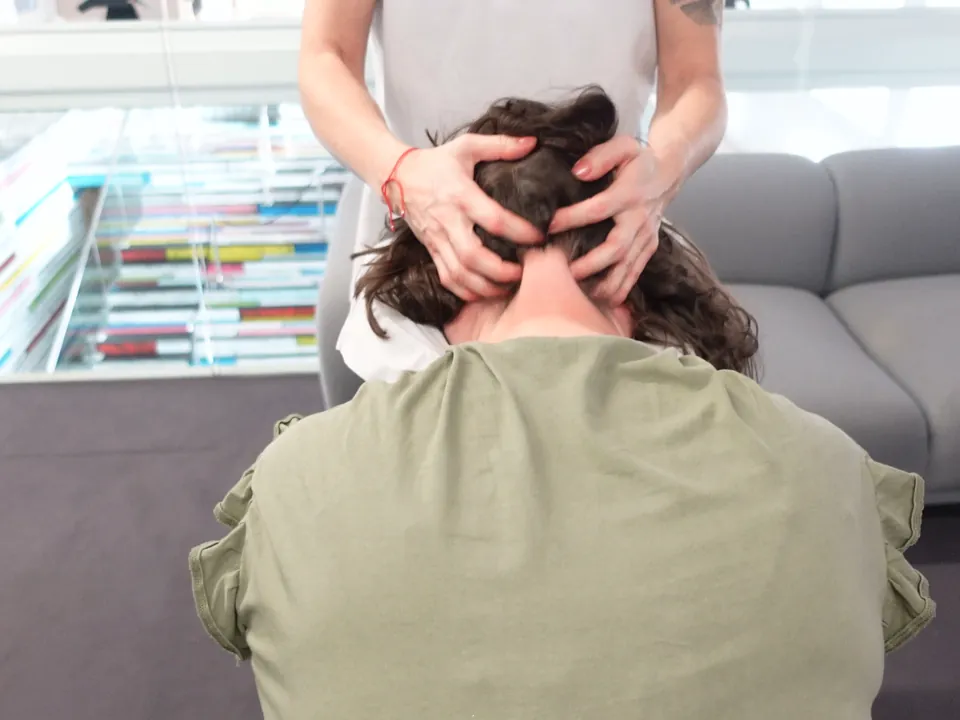
A seated massage usually covers the neck, shoulders and upper and mid back. Depending on the therapist and the type of massage, it can also include the arms and hands, and sometimes the head.
How do people feel afterwards?
In our experience, people usually come away relaxed and refreshed, and feeling looser and better in their body.
There's some research too, although the studies are small:
- In a 1996 study, 26 adults who had a 15-minute chair massage twice a week for five weeks felt less anxious after their massages, and their job-stress scores fell, compared with a group who simply relaxed in the chair (Field and colleagues, 1996).
- In a 2012 pilot study, nurses who had a 15-minute chair massage once a week for ten weeks reported lower stress and anxiety. There was no comparison group, so this is an early result (Engen and colleagues, 2012).
Small studies like these are encouraging rather than proof. If you're a therapist, keep what you tell clients to what the Advertising Standards Authority accepts for massage: helping relaxation, relieving everyday stress, aiding sleep and promoting a sense of wellbeing (ASA).
Why it works so well in an office
- Nobody has to undress. People often don't realise this until they try it.
- It only needs a quiet space. A meeting room, or a quiet corner or area, is enough.
- It fits into a working day. People are back at their desk within minutes, without changing or showering.
- It's easy to fit lots of people in. With 15 or 20 minute slots, one therapist can see up to 18 to 24 people in a day.
Who shouldn't have one
Massage isn't suitable for everyone. Anyone with a health concern that means they can't have a massage should be turned away, for example:
- someone whose doctor has advised them not to have massage
- someone who is unwell, or has signs of flu or an infection
- someone who is pregnant. Some therapists, including us, don't offer seated massage during pregnancy.
If someone isn't sure, they should check with their GP first. It's much easier when people answer these questions before they book, so nobody is turned away at the chair. In Onsite Days, everyone answers your pre-massage questions as part of booking. Our free consultation form covers the questions to ask before a seated massage.
What the company needs to provide
- A quiet space, such as a meeting room, or a quiet corner or area.
- Room around the chair, so the therapist can move around it.
- A way to tell people, such as an email, a message on Teams or Slack, or a poster, with the booking link.
The therapist brings the rest: the chair, face-rest covers, wipes and hand sanitiser. It's fine to ask for a copy of their insurance certificate before the day. Our guide to massage therapist insurance explains what it should cover.
How often companies book
It depends on the company and how committed they are to supporting their people. Some have a therapist in every week, others monthly or quarterly, and some book one-off days, for example for an awareness week or a team event. Regular visits are what make corporate work steady for therapists, and many offer a better rate for them (see offering a better rate for regular days).
How a seated massage day is organised
The massage is the easy part. The organising is where days go wrong, usually when staff run their own spreadsheet. Onsite Days handles the bookings:
- one booking link for everyone at the company
- people pick their own slot, and get a confirmation with a link to change or cancel
- health questions answered when they book
- reminders at times you choose (paid plans)
- the therapist sees the up-to-date list on their phone
- a simple report for the client afterwards (paid plans)
For the full step-by-step, see how to organise bookings for an office chair massage day. The Free plan covers one client site and one day a month, so you can try it on a real day for nothing.
Are you a company looking to book a seated massage? We don't provide therapists, but if you already work with one, ask them to take your bookings through Onsite Days. It's free for them to start, and your staff get one simple link to book.
Sources
- Field T and colleagues (1996). Massage therapy reduces anxiety and enhances EEG pattern of alertness and math computations. International Journal of Neuroscience.
- Engen DJ and colleagues (2012). Feasibility and effect of chair massage offered to nurses during work hours on stress-related symptoms: a pilot study. Complementary Therapies in Clinical Practice.
- Advertising Standards Authority: Therapies, massage and body work