
In the UK? See massage therapist insurance in the UK.
The short answer. Many states don't make liability insurance a condition of your massage license, but some do, and many companies, venues and events that book you on-site will want proof of it.
- What to get. Professional liability (the massage itself) and general liability (slip-and-fall injuries and property damage), often sold together. $2 million per claim or per occurrence is common for massage-specific policies.
- What it costs. Massage-specific policies and association memberships that include liability insurance usually cost about $100 to $240 a year (around $90 in your first year after graduating). Buying general and professional liability as separate policies from a business insurer came to about $857 a year at Insureon's median prices.
- What the law can require. Some states require liability insurance to practice, such as Colorado, Connecticut and Indiana. Once you employ people, almost every state requires most employers to carry workers' compensation. In Texas it's optional for most private employers, and South Dakota doesn't require it at all.
- Before an office day. Check your policy covers you at clients' locations, and keep a certificate of insurance (COI) ready to send.
We've been running on-site chair massage days at offices since 2017, and we built Onsite Days for therapists who do them. We're not insurance experts, and we're not paid by any insurer or association mentioned here. The facts below come from official and industry pages, listed under Sources at the end.
This guide explains what massage insurance covers in the US, what to check before you work at someone else's office, and what changes once you run a team. It's general information, not insurance or legal advice.
Do massage therapists need insurance in the US?
There's no federal rule. It depends on your state, and many states don't make insurance a condition of your license. Some do, including these.
- Colorado requires professional liability insurance of "not less than fifty thousand dollars per claim" with an aggregate (the most the policy pays in total in a year) "of three hundred thousand dollars" [1].
- Connecticut requires licensed massage therapists who provide "direct patient care services" to carry professional liability insurance of at least $500,000 per person per occurrence, with a $1 million aggregate [2].
- Indiana says licensed massage therapists "are required to hold professional liability insurance in order to practice massage therapy", with "a minimum coverage of two million dollars ($2,000,000) per claim and six million dollars ($6,000,000) in aggregate" [3].
Rules change, and other states have their own. Check with your state massage board, especially when you renew your license.
Why you'll want it anyway
- A claim can be expensive. If someone says your massage hurt them, or your chair scratches a client's new floor, you'd pay the legal costs and any settlement yourself.
- Clients and venues ask for it. MASSAGE Magazine, which also sells insurance, puts it plainly: "Schools, employers, landlords, and event organizers may ask for a certificate of insurance" before you provide "massage services on-site" [4].
- It's cheap compared to a day's fee. A year of coverage through a massage-specific policy or association costs about the same as two hours of corporate chair massage at a typical $100 an hour (see costs below).
Professional liability, general liability and the rest
Most massage policies are built from a few parts. Here's what each one is for.
Professional liability
This covers you if someone says the massage itself harmed them. You may see it called malpractice. It's the part that matters most, and it's the part a general business policy may leave out.
AMTA's member policy, for example, covers professional liability "up to $2,000,000 per claim and up to $6,000,000 annual aggregate" [5].
Policies give two limits like these. The first, per claim or per occurrence depending on the insurer, is the most the policy pays for one claim. The aggregate is the most it pays in total in a policy year.
General liability
This covers injury to other people, or damage to their property, that isn't about the massage itself. Think of someone tripping over your chair bag in a hallway, or your cart scuffing a lobby wall. ABMP describes this as "premises liability (or slip and fall)" [6].
Make sure you have both. Massage association memberships usually combine professional and general liability in one policy. Business insurers often sell them as separate policies, and a cheap "general liability" quote may not cover a claim that your massage injured someone.
Read your certificate or policy declarations (the page that lists what you're covered for), and if it isn't clear, ask your insurer "Am I covered if someone says my massage injured them?"

While you're reading your policy, check three more things.
- Occurrence-based or claims-made. Occurrence-based coverage covers anything that happened while you were insured, even if the claim comes after you switch insurers. Claims-made coverage covers only claims made while the policy is active, so if yours is claims-made, ask about "tail" coverage before you switch or stop.
- License defense, if someone complains to your state board.
- Abuse or misconduct defense, even against a false allegation.
Products liability
This covers harm caused by products you use or sell, such as a reaction to a lotion. With chair massage you usually work over clothes without oils, but it's often included anyway. ABMP's covers "external massage products used during the service" [6].
Your own equipment
Liability insurance protects you against claims from other people. It usually doesn't pay to replace your own massage chair if it's stolen from your car or damaged. If you carry a chair in and out of offices every week, ask about equipment or business property coverage, or a business owner's policy (BOP), which combines general liability with property coverage. A BOP usually doesn't cover claims about the massage itself unless you add professional liability, so check.

Workers' compensation
This covers your employees if they're hurt or become ill because of their work. It's set by state law (see If you run a team or agency).
Working at a client's office
Many massage policies follow you wherever you work. ABMP says its coverage applies "no matter where, or how many places you work" [6]. Not every policy is written that way, especially policies tied to one clinic address, so check yours.
Tell your insurer it's seated massage
Many policy pages don't mention chair or seated massage by name. When you buy or renew, tell your insurer you give seated massage over clothes at companies' offices and events, and ask them to confirm by email that you're covered. Keep their reply.
Planning the rest of the day? See what massage therapists wear to an office.
MASSAGE Magazine also points out that during chair massage at an event, "intake may move too quickly for a client to mention a relevant health issue" [4]. Asking your pre-massage questions when people book, instead of in the line, helps with that. With Onsite Days, each person answers your questions as they book, and you can see which version they confirmed and when. It records that they confirmed your questions, not their answers, so it isn't an intake record. For a one-page form you can print, see our free chair massage intake form. Keep whatever records your state board or insurer asks for.
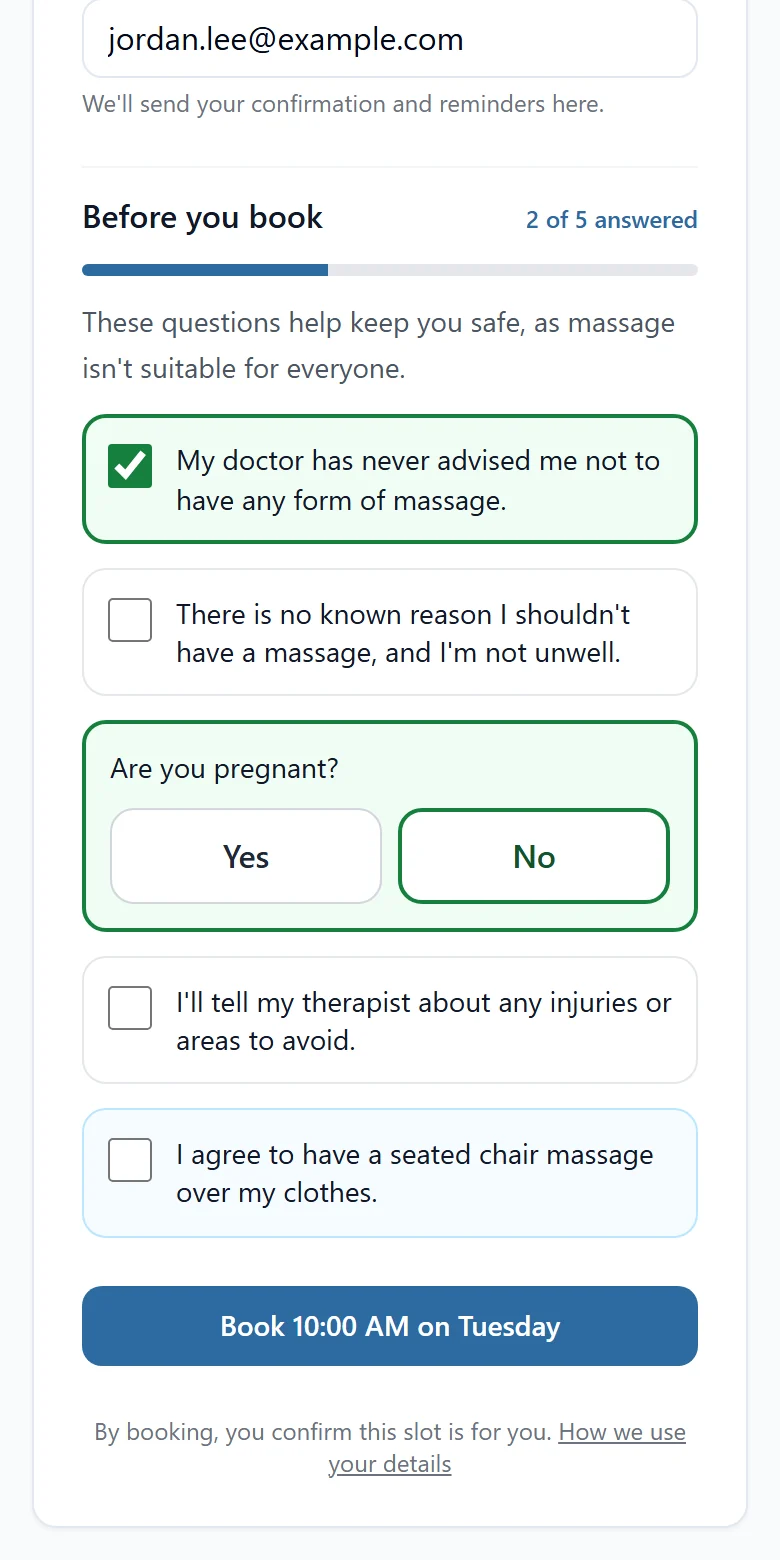
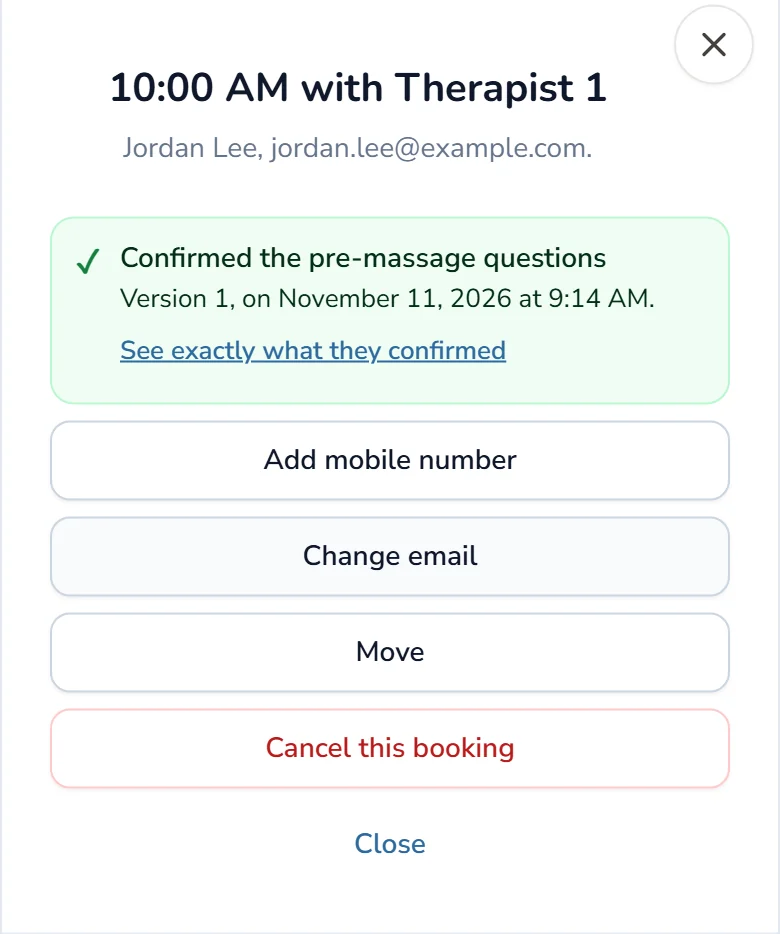
An example account. The business, the company and the people are all made up.
Your license
Insurance doesn't replace a license, and a state's massage license usually covers chair massage too. Mississippi's massage board, for example, says a cosmetologist can't give a chair massage without a massage license, and its rules cover "on-site seated massage sessions" too, which are excused from the usual paperwork such as intake forms [7].
Some cities and counties have their own rules too. In California, state certification is voluntary, but "some cities and counties do require CAMTC certification" [8].
Check your state board's rules and any city rules before you book, because insurers generally expect you to hold whatever license your work needs. If a client has offices in more than one state, check the rules in each state where you'll work.
Your auto insurance
Driving to clients' offices with a chair in the trunk can count as business use. Utah's insurance department says that for business use you "may need a commercial auto policy, or you may need to see if your personal auto policy can be endorsed" [9]. Ask your auto insurer before your first office day.
What companies ask for
A certificate of insurance (COI)
This is the most common request. A COI is a one-page summary of your coverage. Send that, not your whole policy. ABMP, for example, says "proof of insurance will be available by logging in" to your account [6]. Ask your association or insurer how to get yours.
Keep a PDF of it on your phone so you can send it right away, and send the new one when you renew.
Being the certificate holder
Often a company just wants to be the certificate holder, which means its name and address go on your COI. That gives it no coverage. Connecticut's insurance department explains that a certificate "confers no rights or benefits upon the third party certificate holder" [10]. It's usually quick to do from your association's or insurer's website.
Being named as an additional insured
Some companies, building managers and event venues want more than that: to be added to your policy as an "additional insured", which extends your liability coverage to them for claims arising from your work. As Connecticut's insurance department puts it, to get that protection the certificate holder "would need to be named an 'Additional Insured' by endorsement" [10]. An endorsement is a written change added to your policy.
It sounds complicated but usually isn't. ABMP says "There is no extra charge for obtaining an additional insured endorsement" [6], and AMTA adds one "for no extra charge" too [11]. Ask your contact for the exact legal name and address to put on it, and ask your insurer how long it takes.
A particular amount of coverage, sometimes
Some corporate contracts and venues ask for a minimum amount of coverage. ABMP's policy carries $2 million per occurrence and AMTA's $2 million per claim, both with a $6 million yearly aggregate, and AMTA's general liability sits within the same limits [6] [5]. That's more than many organizations ask for. The City of San Diego's insurance checklist for its contractors, for example, gives its minimum general liability limits as "$1 million per Occurrence and $2 million General Aggregate" [12]. If a contract asks for more, ask your insurer whether you can raise your limits.
Read the contract too
Some corporate and venue contracts ask for more than a certificate, such as "primary and non-contributory" coverage (your policy pays before theirs) or a waiver of subrogation (your insurer agrees not to try to get its money back from them), shown by an endorsement. San Diego's checklist, for example, asks for endorsements "separate from the Certificate of Insurance" [12].
Contracts can also include an indemnification or "hold harmless" clause. That's a promise you make in the contract, separate from your insurance. Before you sign, send the insurance and indemnification sections to your insurer or broker and ask whether your policy covers what they ask of you. If a clause is broad, get legal advice.
If you run a team or agency
Workers' compensation once you employ people
Workers' comp is run by each state. Almost every state requires most employers to carry it, though the number of employees that triggers it varies. In Texas it's optional for most private employers [13], and South Dakota doesn't require it at all [14]. The US Department of Labor keeps a directory of state workers' compensation offices, so you can "find the name and address of the appropriate state workers' compensation official" for yours [15].
If you work alone, you usually don't have to cover yourself. Florida, for example, says sole proprietors and partners outside construction "are not employees unless they want to be included" [16]. A company's vendor form may still ask for a workers' comp certificate. If you have no employees, tell them so and ask what they'll accept, such as a signed statement. If you've set up an LLC or corporation, check your state's rules for owners, as they can differ.
Calling therapists contractors doesn't settle it
Whether someone is an employee or an independent contractor depends on how you really work together. The IRS says "The keys are to look at the entire relationship and consider the extent of the right to direct and control the worker" [17]. If you control how they work and supply their chair, they may count as employees. That's the federal tax test, and many states use stricter ones.
California uses an "ABC test." One of its conditions is that the worker "performs work that is outside the usual course of the hiring entity's business" [18]. A therapist giving massages for a company that sells massage is unlikely to meet it, as MASSAGE Magazine has explained [19], so in California your therapists are likely to count as employees whatever your contract says. Before you build a team on contractors, ask an accountant or employment lawyer in your state.
Check every therapist's own coverage
If your therapists are contractors, ask each one for their COI before they work for you, make sure it covers seated massage at clients' locations, and note their renewal dates on your calendar. Some clients will ask you to show coverage for everyone you send.
Association insurance covers you as an individual member. ABMP's limits, for example, are "per member, per year" [6]. Each therapist needs their own coverage, and your business may need its own policy. Adding your business name to a policy as an additional insured isn't the same as the business being fully covered, so ask a broker about a policy for the business itself.
How much is massage insurance in the US?
For a self-employed massage therapist, a massage-specific policy or an association membership that includes liability insurance usually costs about $100 to $240 a year, or around $90 in your first year after graduating. Buying from a general business insurer usually costs more, especially if you need general and professional liability as separate policies.
These are the figures we found when we checked in November 2026. They don't all include the same coverage, so compare what's in each, not just the price. Check any policy meets your state's minimum. Indiana, for example, asks for a $6 million aggregate, more than some policies carry.
- ABMP and AMTA first-year price for new graduates, with liability insurance [20] [21]$89
- Insurance Canopy starting price for massage therapists, general and professional liability, $2 million per occurrence [22]From $96
- ABMP Professional membership, with liability insurance [20]$199
- ABMP Certified membership, with liability insurance (or $20 a month) [20]$229
- AMTA Professional membership, with liability insurance ($20 a month comes to $240) [21]$235
- General liability on its own, $1 million per occurrence, median for Insureon's wellness customers [23]$357
- Professional liability on its own, $1 million per occurrence, Insureon median [23]$500
- Business owner's policy (general liability and property), Insureon median [23]$979
Association prices are for membership, which includes liability insurance and other benefits, with the limits given above. AMTA's members also share a master policy limit of $10 million, which ABMP doesn't have. Insurance Canopy's is $2 million per occurrence with a $3 million aggregate, and its price is a starting price. Insureon's figures are medians of policies its customers bought, updated April 2025, and usually have lower limits than the association policies. Its professional liability median came with a $1 million aggregate and a $750 deductible (the amount you pay toward a claim yourself). Workers' compensation for employers was a median of $604 a year with Insureon.
Build it into your rates. Our guide to chair massage prices in the US covers the rest of your costs.
Quick checklist
Three things to do this week
- Download your COI and check it lists professional liability as well as general liability.
- Email your insurer and ask: "I give seated chair massage over clothes at companies' offices and events. Am I covered for this, including if someone says my massage injured them?" Keep their reply.
- Save your COI as a PDF on your phone.
Everything to check
- Professional liability (the massage itself) and general liability
- Coverage at clients' locations, not only your own address
- Seated massage confirmed by your insurer
- Your state's insurance rules for your license
- Equipment or property coverage for your chair
- Occurrence-based coverage, license defense and abuse or misconduct defense
- Business use on your auto policy, if you drive to clients
- A PDF of your current COI on your phone
- Whether a company wants to be the certificate holder or an additional insured, and how long each takes
- The insurance and indemnification sections of any contract, checked with your insurer before you sign
- Any license or permit your state or city needs for chair massage
- Workers' compensation, if you employ anyone
- Every contractor's own COI, if you run a team
This guide is general information, not insurance or legal advice. Policies and state rules differ, so check the details with your insurer, broker or state board before you buy.
Sources
- Colorado Revised Statutes, section 12-235-116: Professional liability insurance required
- Connecticut General Statutes, chapter 384a, section 20-206i: Professional liability insurance
- Indiana Professional Licensing Agency: Massage therapy licensing information
- MASSAGE Magazine: Do massage therapists need liability insurance? (updated May 2026)
- AMTA: What does AMTA liability insurance cover?
- ABMP: Massage liability insurance
- Mississippi State Board of Massage Therapy: Frequently asked questions (August 2025)
- California Massage Therapy Council: FAQs
- Utah Insurance Department: Business use of your auto
- Connecticut Insurance Department: Bulletin S-14, Use of certificates of insurance (November 9, 2010)
- AMTA: Additional insured
- City of San Diego: Purchasing and contracting insurance checklist (revised January 2017)
- Texas Department of Insurance: Workers' compensation for employers
- South Dakota Department of Labor and Regulation: Workers' compensation
- US Department of Labor: State workers' compensation officials
- Florida Department of Financial Services: Workers' compensation coverage requirements
- IRS: Independent contractor (self-employed) or employee?
- California Labor and Workforce Development Agency: ABC test
- MASSAGE Magazine: New perspectives on the California Supreme Court decision on independent contractors (December 2019, updated March 2026)
- ABMP: Memberships for practitioners
- AMTA: Membership
- Insurance Canopy: Massage therapist insurance
- Insureon: Massage therapist insurance cost (updated April 2025)
Sources checked on November 10, 2026. Prices, policy wording and state rules change often.