
The short answer: self-care for massage therapists means looking after the body you work with. Use your body weight instead of your thumbs, keep your wrists straight, warm up and stretch your hands and forearms, and plan real breaks into every day. Cut the stress around the work too, such as chasing bookings and no-shows, and see a doctor early if pain or numbness doesn't go away.
I've been running chair massage days at offices since 2017, and I used to give the massages myself. A full office day is one person after another, hours on your feet, and a lot of work for your hands and thumbs. Looking after yourself is what lets you keep doing it for years.
This guide is for massage therapists, especially on chair massage days at offices and events.
Why self-care matters
Pain is common in this work. In a survey of massage therapists in Ontario, Canada, published in 2022, 85% had experienced work-related pain, and the hand or wrist was the most common place, reported by 65.5% [1]. Almost a quarter (24%) said their pain had led them to change, or consider changing, their profession [1].
The same survey found that what helped included more rest between clients and a regular self-care routine [1]. Self-care isn't a treat for later. It's part of the job.
Body mechanics for massage therapists
How you stand and move matters more than how strong you are.
- Use your body weight, not your arm strength. New Jersey massage therapist Toni-Ann Accardi told AMTA's journal to "move your body to make the stroke, as opposed to pushing and pulling with your arms" [2]. Lean in from your legs and hips.
- Keep your wrists straight. Working with a bent wrist puts the joint out of alignment [2].
- Spare your thumbs. Becky SanGregorio told the same article that for every pound of pressure through your thumb, there can be 10 to 12 pounds on the joint at its base [2]. For deeper pressure, use your forearm, as in the photo above, your elbow or a loose fist, with your wrist straight.
- Vary your techniques. Repeating the same deep work all day raises the risk of injury [2], so mix your strokes through each session.
Setting up the massage chair
When I gave the massages myself, I made sure the chair was at a comfortable height for the client, and that I was positioned to ease the pressure on my own body.
- Set the seat height so the person's upper back is around your waist to hip height. Too low and you stoop; too high and your shoulders hike up.
- Adjust the chest pad and face rest so their back is close to you, not leaning away.
- Stand in a lunge, one foot ahead of the other, so you shift your weight instead of bending at the waist. For the neck and upper shoulders, step to the side of the chair and stay tall, keeping your wrists straight. Bend your knees, not your back.
- For the lower back and arms, kneel on one knee or sit on a low stool rather than bending over.
- Keep your shoulders down and your elbows close to your body, and move around the chair rather than stretching across it.
Stretches for massage therapists
A minute or two of warm-up before your first client, and a few stretches in your breaks, help keep your hands and forearms loose. These come from HealthLinkBC's wrist exercises, reviewed by doctors including a hand surgeon [3]. Don't do any stretch that's uncomfortable or painful, and if you already have pain, numbness or an injury, check with a doctor or physical therapist first.
HealthLinkBC lists 1 to 3 as warm-up stretches [3]. Do them before your first client, and 4 to 6 in your breaks.
-
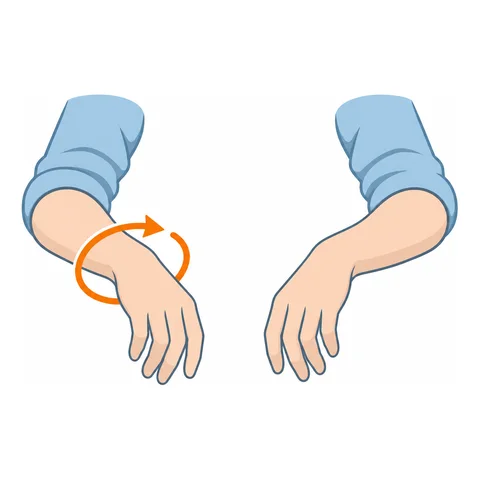
Wrist circles
Rotate your wrists up, down and from side to side.
4 times
-
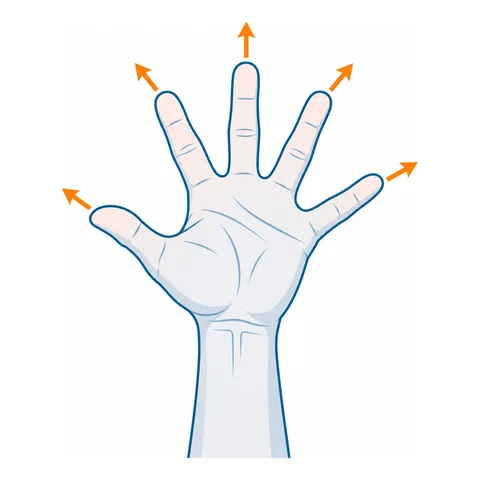
Finger spread
Stretch your fingers far apart, relax them, then stretch them again.
4 times
-
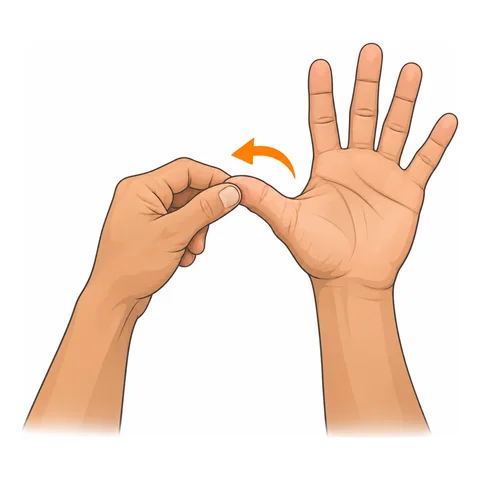
Thumb stretch
Gently pull your thumb back, hold, then release.
4 times
-
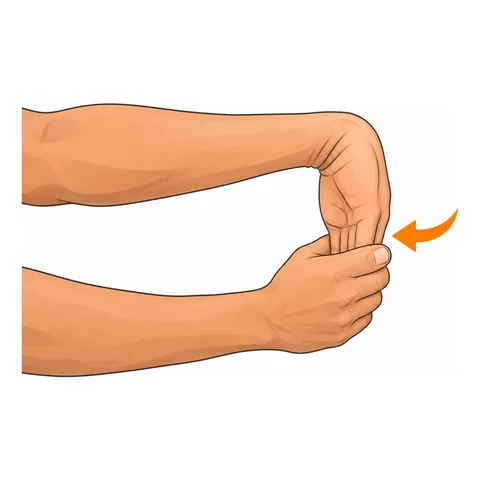
Wrist flexor stretch
Hold one arm straight out, palm up. Bend your wrist so your fingers point to the floor, then use your other hand to ease it a little farther until you feel a mild to moderate stretch in your forearm. Switch arms.
Hold at least 15 to 30 seconds, 2 to 4 times
-
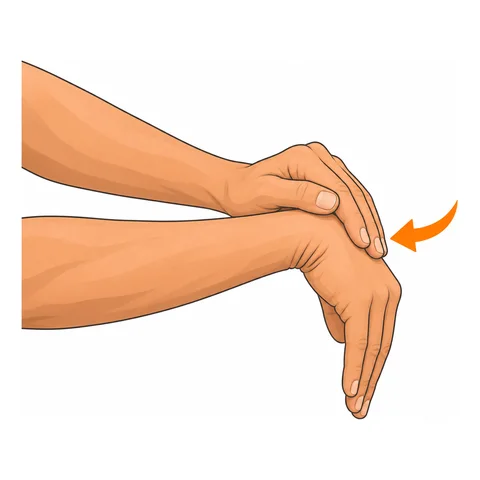
Wrist extensor stretch
The same as the flexor stretch, but start with your palm facing down.
Hold at least 15 to 30 seconds, 2 to 4 times
-
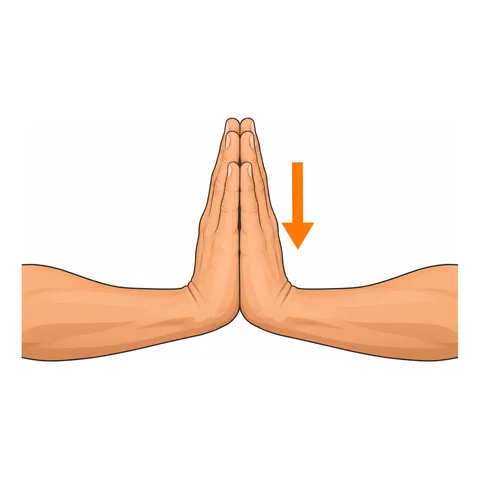
Prayer stretch
Press your palms together under your chin. Keeping them together, lower your hands toward your waist until you feel a stretch under your forearms.
Hold at least 15 to 30 seconds, 2 to 4 times
Add a few shoulder rolls and a gentle neck stretch too, as your upper back works hard on a chair massage day.
Breaks and pacing your day
- Plan real breaks. On our days, we plan a 30-minute break every two hours, and no more than six hours of massage in a day. Your breaks come on top of the massage hours, so build them into your day rate.
- Leave a few minutes between clients. It gives you time to wipe down the chair, shake out your hands and greet the next person, and it keeps the day running on time.
- Eat and drink. Bring water and food you can eat quickly, and actually stop to have them.
- Space out your week. Toni-Ann Accardi keeps to four days a week and no more than five hours a day [2]. Find a pattern your body can keep up.
If you're still setting your rates, our chair massage prices guide shows how to price a day that includes breaks.
After the day
- Rest your hands. One therapist in AMTA's article ices after a rough day and uses heat at other times [2]. Do what helps you, and don't follow a long day with heavy work for your hands.
- Look after your skin. Hand sanitizer and washing all day dry and crack your skin, so moisturize at breaks and at night.
- Get a massage yourself. Trade treatments with other therapists near you [2], or book a regular session.
- Keep the rest of you strong. General fitness, especially your legs and core, takes load off your arms and back.
Cutting the stress around the work
Self-care isn't only physical. A lot of the stress in this work comes from around the massage: chasing a sign-up sheet, answering "is there still a slot at 2?", a gap from someone who forgot, and the worry that the day won't fill.
- Make booking easy for everyone. One booking link for each office, where people pick their own slot, takes the back-and-forth off your plate. Our chair massage sign-up sheet guide covers the paper version if you're starting out.
- Send reminders. A reminder before each slot means fewer people forget.
- Protect your breaks. If your breaks are in the schedule, nobody can book over them.
Onsite Days handles this for you. It's free to start, and on the paid plans people get reminders and a waiting list fills slots when someone cancels. Try Onsite Days free.
Common massage therapist injuries and hand pain
In the same survey, after the hand and wrist (65.5%), the most common places for work-related pain were the fingers or thumb (60.3%), shoulder (55.0%), lower back (50.1%) and neck (48.3%) [1]. The joint at the base of the thumb takes a lot of load, as above, which is why sparing your thumbs matters so much.
This guide is general information, not medical advice. See a doctor or physical therapist if pain in your hands, wrists, arms or back doesn't improve with rest, or if you have numbness, tingling or weakness in your hands. Getting help early is easier than working through it and making it worse.
Self-care checklist
- Warm up your hands and wrists before your first client.
- Lean in with your body weight, and keep your wrists straight.
- Use your forearm or elbow for deep pressure, not your thumbs.
- Set the chair to suit you, and stand in a lunge.
- A 30-minute break every two hours, and a few minutes between clients.
- Stretch in your breaks.
- Water and food you'll actually stop for.
- Hand cream for breaks and the evening.
- Comfortable shoes. See what massage therapists wear.
Self care for massage therapists: common questions
What is self-care for massage therapists?
Looking after your hands, body and energy so you can keep working without pain: good body mechanics, stretching, breaks, rest, and less stress around the work.
What stretches should massage therapists do?
A wrist, finger and thumb warm-up, wrist flexor and extensor stretches and the prayer stretch, plus shoulder and neck stretches. See Stretches for massage therapists.
How do massage therapists prevent hand pain?
Use your body weight and your forearm or elbow instead of your thumbs, keep your wrists straight, warm up, stretch in your breaks and don't overload your week.
How many massages can a therapist do in a day?
It depends on the length of each massage and your own body. On our days, we plan no more than six hours of massage in a day, with a 30-minute break every two hours.
How do massage therapists avoid burnout?
In the survey above, almost a quarter of therapists had changed, or were considering changing, their profession because of pain [1]. Pacing your week, protecting your breaks, getting treatment yourself and cutting the admin around the work all help.
Sources
- Barraclough W, Baskwill A, Higgs C, Neilson S, Wilcox D. A Survey of Canadian Massage Therapists' Experiences of Work-Related Pain. International Journal of Therapeutic Massage & Bodywork, 2022
- AMTA, Massage Therapy Journal: Self-Care: Your Massage Therapy Career is in Your Hands (2017)
- HealthLinkBC: Stretching exercises for the wrists
Sources checked on November 14, 2026. This guide is general information, not medical advice.