
The short answer: download our free chair massage consultation form as a printable PDF or a Word file you can edit. No email needed. It's one A4 page, written for a seated massage over clothes: nine short questions, a consent section, and signature lines for you and your client.
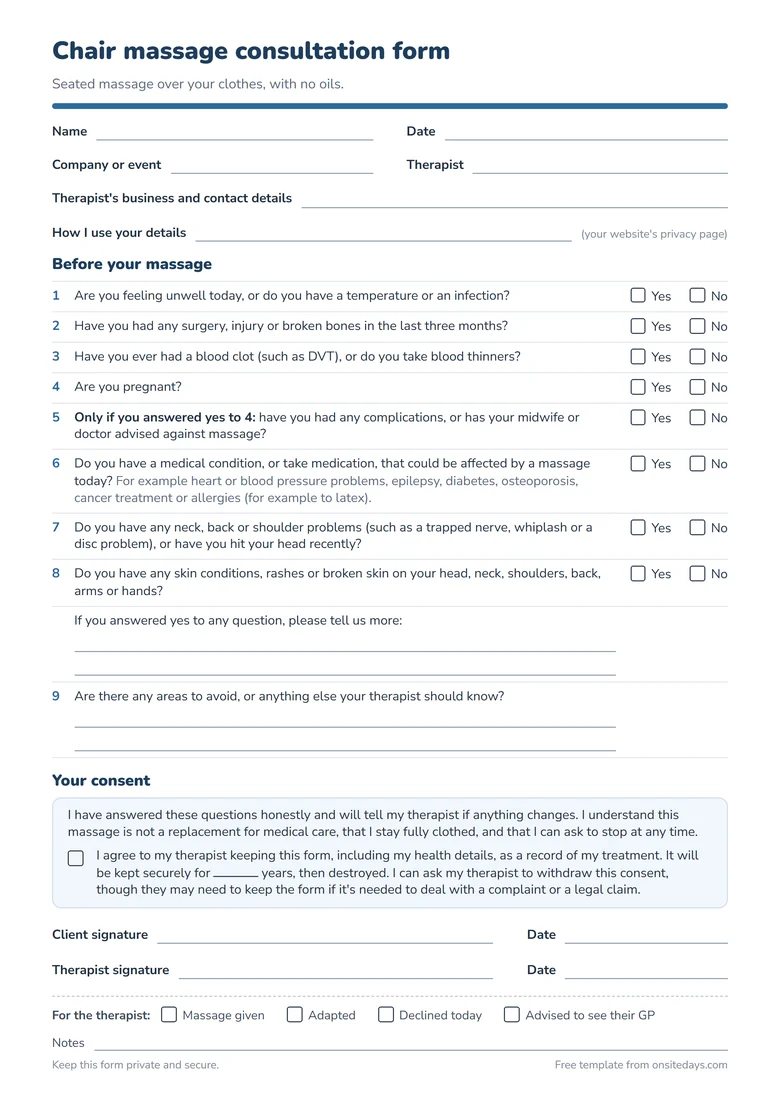
We've been running on-site chair massage days at offices since 2017. On an office day you might see someone new every 15 or 20 minutes, sitting fully clothed in a massage chair in a meeting room. A four-page clinic form doesn't fit that. Most of the questions don't apply to a short seated massage, and people waiting in line won't fill it in properly anyway. We've also had to turn people away at the chair because they were pregnant, which is a hard moment for everyone.
Some therapists call it a client consultation form, a health questionnaire or a massage intake form; it's the same thing. This one keeps the questions that matter for a seated massage, gives you a signed record, and fits on one page. It's general information, not legal, insurance or medical advice, so check it against what your own insurer and professional body ask for.
Do you need a consultation form for chair massage?
If you belong to a professional body, almost certainly yes. The Federation of Holistic Therapists' code says "A full, written consultation must be carried out for all clients prior to treatment", and "The completed consultation form must be signed and dated, by both the member and the client" [1].
For shorter treatments, the same code allows a shorter form: "When providing taster treatments, a written consultation form must still be completed, however an approved, shorter consultation form may be used" [1]. The code says members insured through the FHT can use the FHT's own approved taster form, but the web page it points to no longer exists, so ask the FHT for it. The code doesn't define a taster treatment either, so if you're an FHT member, ask whether your office days count, and whether you should use the FHT's form instead of this one.
The Complementary Therapists Association asks its members to keep "clear and comprehensive records of their treatments", including "all consent forms" [2]. Insurers expect records too. Balens, for example, says to record "Details of any pre-treatment/session consultation including the presenting issue, relevant medical conditions, medications, allergies and contraindications" [3].
A consultation form is also simply the quickest way to spot the occasional person who shouldn't have a massage today.
What to ask on a massage consultation form
The first eight questions are answered yes or no, and the last one is open, so it only takes a minute or two. Anyone who ticks "yes" has space to tell you more. A "yes" doesn't always mean no massage. It means you talk to them before you start, and adapt the massage or decline it for today. (Our guide to seated massage at work covers who it suits.) The FHT's code puts it this way: "if the member has any concern regarding the client's health and safety, the member must decline, defer or stop treatment" [1].
1. Are you feeling unwell today, or do you have a temperature or an infection?
Someone with a fever or an infection should wait until they're better, both for their own sake and for the next person in your chair.
2. Have you had any surgery, injury or broken bones in the last three months?
Serious problems after a massage are rare, but they do happen. The US National Center for Complementary and Integrative Health notes that "there have been rare reports of serious side effects, such as a blood clot, nerve injury, or bone fracture" [4]. Recent surgery or an injury is a reason to avoid an area, or the whole massage. Three months gives people a clear line to answer against.
3. Have you ever had a blood clot (such as DVT), or do you take blood thinners?
A clot is the most serious thing to rule out. As one massage therapist told the American Massage Therapy Association's journal, "If you have a DVT diagnosis or have a positive screening, you postpone the massage until it resolves" [5]. Blood thinners matter too, because they make bruising more likely, so you may need lighter pressure [6]. The form asks "ever" on purpose, so you can have a quick word about it, even if it was years ago.
4 and 5. Are you pregnant? If so, have you had any complications, or advice against massage?
These are two questions so each has a clear yes or no, and question 5 starts "Only if you answered yes to 4", so everyone else can skip it. Advice on massage in pregnancy isn't consistent, and some therapists don't massage in early pregnancy at all. Where there are complications, the AMTA's journal suggests therapists "should consider requiring a medical release" [5]. Your insurer and professional body may have their own rules on pregnancy, so follow those.
6. Do you have a medical condition, or take medication, that could be affected by a massage today?
This catches what the other questions miss, without asking for a full medical history. Most people can't judge on their own what "could be affected" means, so the form gives examples: heart or blood pressure problems, epilepsy, diabetes, osteoporosis, cancer treatment or allergies. Allergies are on the list because insurers ask you to record them [3], and because of latex gloves, cleaning wipes and face rest covers. A few examples of why it matters: people on blood pressure medicine may feel light-headed getting up, so the AMTA suggests you "Remind your clients to sit up and stand slowly"; painkillers can make it harder for someone to tell you if the pressure is too much; and long-term steroids can weaken tissue [6].
7. Do you have any neck, back or shoulder problems, or have you hit your head recently?
On a chair, the neck, shoulders and upper back are most of the massage, so it's worth asking about them directly. A trapped nerve, whiplash, a disc problem or a recent knock to the head is a reason to adapt the massage, avoid an area, or decline it for today.
8. Do you have any skin conditions, rashes or broken skin on your head, neck, shoulders, back, arms or hands?
Even over clothes, you'll touch the neck, scalp, arms and hands. Avoid open wounds and anything that could spread, and keep the face rest cover fresh for each person.
9. Are there any areas to avoid, or anything else your therapist should know?
The open question. It's where people tell you about a stiff shoulder from their desk, a sore wrist, or that they don't like their head being touched.
The consent section
The form's consent section does two jobs.
- Consent to the massage. They confirm they've answered honestly, that the massage isn't a replacement for medical care, that they stay fully clothed, and that they can ask you to stop at any time. The FHT reminds members that "Consent is a continuous process and not a one-off event" [1], so check in during the massage too.
- Consent to keeping their health details. Under UK GDPR, information about someone's health is "special category" data [7], which needs extra care (more on that below). The second paragraph has its own tick box, so it's a separate, clear agreement for you to keep the form, with their health details, as a record of their treatment. It has a blank for how many years you keep forms, as the FHT says clients "must be told how long their personal data will be kept" [1], and it tells them they can ask to withdraw that consent, though you may need to keep the form if it's needed to deal with a complaint or a legal claim.
Both you and the client sign and date it, as the FHT's code asks [1]. If someone signs but doesn't tick the second box, don't sort it out in front of the queue. Ask your insurer now what they'd like you to do, so you have an answer ready on the day.
What to leave off the form
Keep to what you need for a short seated massage. The FHT's code says "Only information relevant to treatment should be covered in the consultation" [1], and data protection law says the same about personal data generally.
- A full medical history. Question 6 covers what matters for today.
- Their home address, date of birth or GP's details. You rarely need them for an office day, and every extra detail is something else to keep safe.
- Anything the company could see. The form is between you and the person in your chair, so don't give their employer a copy.
If you change the questions in the Word version, keep that in mind: every question you add is more health information to look after.
Using the form on an office day
- Bring a clipboard, pens and spare forms. Hand the form over as the person sits down, or to the next person while you're finishing the one before.
- Read it before you start. A quick glance at the ticks takes seconds. Talk through any "yes" quietly, where colleagues can't hear.
- If you have to turn someone away. Keep it short and kind, and out of earshot: "Thanks for telling me. I'm not able to give you a massage today, and that's to keep you safe, not anything you've done. I'd love to see you next time."
- If someone won't fill it in. Without a completed form you can't give the massage: "I need this for every massage, it only takes a minute. If you'd rather not, that's fine, but I can't treat you without it."
- Regulars. If you visit the same office every month, check what your professional body asks for repeat clients. Many therapists use a full form on the first visit, then ask "Has anything changed since last time?" and get a signature and date each visit after that.
- Keep completed forms out of sight. A pile of forms on the desk in a busy meeting room is a pile of health information. Put each one in a folder or envelope as soon as it's signed, and keep the folder with you, not in the car, until you're home. If you scan them and shred the paper, store the scans somewhere password-protected, and remember that digital copies usually mean paying the ICO fee.
- Note what happened. The "For the therapist" line at the bottom is for ticking whether the massage went ahead, was adapted or was declined for today, and whether you advised them to see their GP, with a short note.
- Bring business cards. People often ask how to book you again. Make yours with our free business card maker. For your clothes and shoes, see what to wear for chair massage at an office.
- Check anyone under 18. Office days can include apprentices aged 16 or 17. If someone is under 18, check what your professional body asks for before you go ahead.
Keeping the forms: UK GDPR and how long
The Information Commissioner's Office (ICO) has guidance for small businesses. Here's what it means for a consultation form.
The basics
- Why you can keep it. Health details are "special category" data, so you need a clear reason to keep them [8]. Most therapists ask for the client's explicit consent, which is what the tick box on this form does [9]. Even if someone later withdraws it, you can usually keep the form if it might be needed for a complaint or a legal claim; Balens puts it as "Records may be kept where this is necessary for the establishment, exercise or defence of legal claims" [3]. Your insurer can confirm what they expect.
- A privacy notice. The FHT's code says clients should get one "at the point when a client's personal data is first requested" [1]. On an office day the form is usually the first time you ask for anything, so a short notice on your website, with a line on the form pointing to it, is a good place to start. It should say what you keep, why and for how long, and who you are and how to contact you, which is why the form has a line for your business and contact details.
- The ICO fee. Unless they're exempt, businesses that keep personal data on a computer or phone must pay the ICO a data protection fee. For a small business it's £52 a year [10]. Records kept only on paper can be exempt [11], but if you email, scan or use any booking software, you'll most likely need to pay. The ICO's website can help you check.
- Keep them locked away. Paper forms in a locked drawer or box. Scans or photos in a secure, password-protected place, never on a shared phone.
How long to keep them
UK GDPR doesn't set a number of years [12]. Your professional body and insurer do, and they don't agree:
- FHT: at least 5 years, for members insured through the FHT [1].
- CThA: at least 7 years [2].
- Balens: at least 7 years for adults [3].
- CNHC: 8 years from the client's last visit [13].
If your professional body and your insurer give different numbers, keep forms for the longer of the two, then securely destroy them. The form leaves a blank for the number of years, so fill in yours (or type it into the Word version once).
Asking the questions before the day
A paper form has one weakness: you only see the answers when the person is already sitting in your chair, and the next person is already waiting. If someone shouldn't have a massage, you find out at the last minute, and that slot is lost.
We've had it on our own days: people turned away at the chair because they were pregnant. If they'd booked online and answered the questions then, they'd have found out before they came down. Filling in a form on arrival also takes longer than you'd expect, and it holds up the queue. It's much quicker when people have already answered the questions before the day.
With Onsite Days, staff answer your pre-massage questions when they book, on their phone, in their own time. You write the questions, and for each yes or no question you choose which answer can go ahead and the message people see otherwise, for example "Sorry, we can't offer chair massage during pregnancy." If someone's answer means no massage, they're told before they book, so the slot stays free for someone else. You still need the form on the day, because some things, like feeling unwell, can only be asked on the day. But the big questions have already come up, so it's quicker to go through.
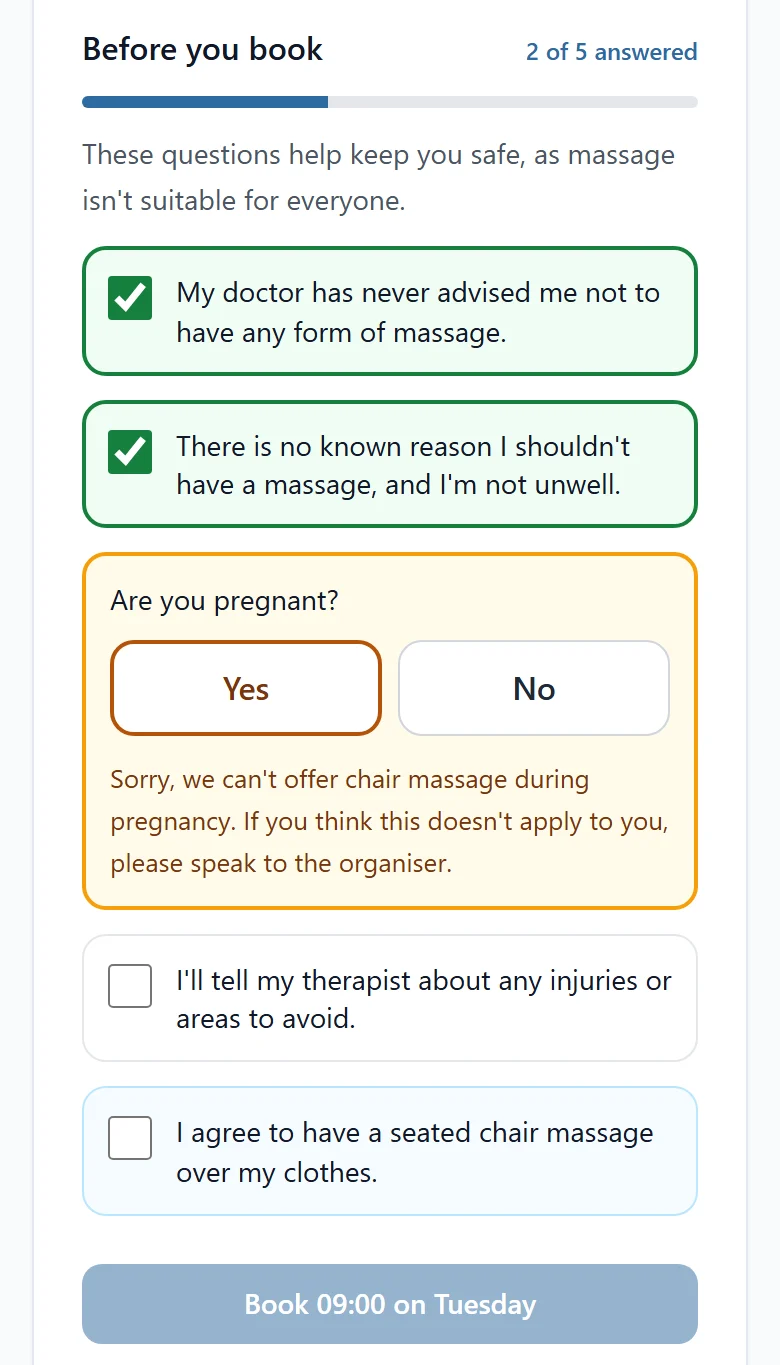
An example account. The business, the company and the people are all made up.
The app records that each person confirmed your questions, which version they saw and when, but not their tick-box or yes or no answers. So it isn't a signed consultation record. If your insurer or professional body asks for one, use this form alongside it. Our guide to organising chair massage bookings covers the rest of the booking side, and our guide to massage therapist insurance in the UK covers what your insurer expects.
Quick checklist
- Download the form. In the Word version, add your name or logo (and delete our footer line if you like).
- Fill in your business and contact details, and your privacy page, before you print copies.
- Check whether your professional body wants its own form for short treatments.
- Pack a clipboard, pens, spare forms and a folder for completed ones.
- Read every form before you start, and talk through any "yes" in private.
- Decline for today if you're not sure it's safe.
- Sign and date each form yourself.
- Keep forms locked away, for as long as your insurer or professional body says.
- Check whether you need to pay the ICO data protection fee.
This guide is general information, not legal, insurance or medical advice. Rules differ between professional bodies and insurers, so check the details with yours.
Sources
- Federation of Holistic Therapists: Code of Conduct and Professional Practice (revised July 2024)
- Complementary Therapists Association: Code of Practice
- Balens: Record keeping, what every health and wellbeing practitioner needs to know
- National Center for Complementary and Integrative Health: Massage therapy, what you need to know (May 2019)
- American Massage Therapy Association: Massage and pregnancy (June 2018)
- American Massage Therapy Association: Massage and medication (December 2014)
- ICO: What is special category data?
- ICO: What are the rules on special category data?
- ICO: What are the conditions for processing?
- ICO: Guide to the data protection fee
- The Data Protection (Charges and Information) Regulations 2018, Schedule
- ICO: Storage limitation
- Complementary and Natural Healthcare Council: Code of Conduct, Ethics and Performance
Sources checked on 11 November 2026. Professional codes, insurers' rules and the ICO's guidance change, so check the current versions.