
The short answer: download our free chair massage intake form as a printable PDF or a Word file you can edit. No email needed. It's one Letter-size page, written for a seated massage over clothes: nine short questions, a consent section, and signature lines for you and your client.
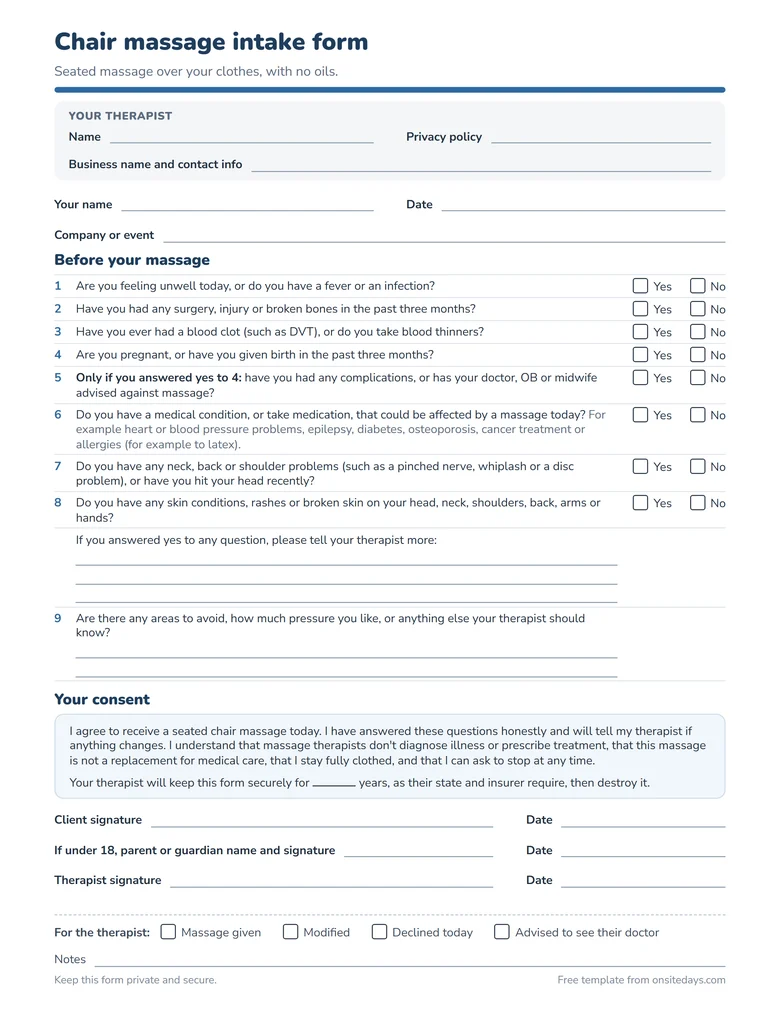
We've been running on-site chair massage days at offices since 2017. On an office day you might see someone new every 15 or 20 minutes, sitting fully clothed in a massage chair in a conference room. A four-page clinic intake form doesn't fit that. Most of the questions, like insurance details and a body diagram, don't apply to a short seated massage, and people waiting in line won't fill it out properly anyway.
A massage intake form is a short questionnaire your client fills out before the massage, with their health questions and consent, so you can decide whether to go ahead, adapt the massage or decline it. Ours does the job of a client intake form, a short health history and a consent form in one. It keeps the questions that matter for a seated massage, gives you a signed record, and fits on one page. If you need a full intake form for table massage in your own practice, AMTA has a free one [2]. This one is only for short seated sessions. This guide is general information, not legal, insurance or medical advice, so check the form against what your state board and your insurer ask for.
Do you need an intake form for chair massage?
There's no single US rule. It depends on your state, your insurer and your professional association, but it's what both main associations advise, and for most therapists it's worth doing.
Associated Bodywork & Massage Professionals (ABMP) has guidelines for public demonstrations, which it hopes members apply to "chair or table massage demonstrations, as well as in your own practice". It says: "Members are advised to have all individuals complete the intake form before receiving a demo massage/bodywork session" [1]. The same guidelines say to politely refuse the massage if someone has a condition that rules it out, needs a doctor's consent, or "refuses to complete the form" [1].
The American Massage Therapy Association (AMTA) puts it simply: "Fill out a client intake form to fully understand your client before you begin your massage session" [2].
State rules differ a lot. Mississippi's massage board, for example, says that "public, sports, and on-site seated massage sessions" are exempt from documentation, though a health history is required for other clients [3]. Most states aren't that specific, so check with your state board. Even where the paperwork isn't required, a short intake form is the quickest way to spot the occasional person who shouldn't have a massage today, and a signed form is a useful record if anything is ever questioned.
What to ask on a chair massage intake form
The first eight questions are answered yes or no, and the last one is open, so it only takes a minute or two. Anyone who checks "yes" has space to tell you more. A "yes" doesn't always mean no massage. It means you talk to them before you start, and adapt the massage or decline it for today. (Our guide to seated massage at work covers who it suits.) ABMP's guidelines ask the same thing of you: is the condition one that rules massage out, and are there "any local, regional, or technique precautions" to take [1]?
1. Are you feeling unwell today, or do you have a fever or an infection?
Someone with a fever or an infection should wait until they're better, both for their own sake and for the next person in your chair.
2. Have you had any surgery, injury or broken bones in the past three months?
Serious problems after a massage are rare, but they do happen. The National Center for Complementary and Integrative Health notes that "there have been rare reports of serious side effects, such as a blood clot, nerve injury, or bone fracture" [4]. Recent surgery or an injury is a reason to avoid an area, or the whole massage. Three months gives people a clear line to answer against.
3. Have you ever had a blood clot (such as DVT), or do you take blood thinners?
A clot is the most serious thing to rule out. As one massage therapist told AMTA's journal, "If you have a DVT diagnosis or have a positive screening, you postpone the massage until it resolves" [5]. Blood thinners matter too, because they make bruising more likely, so you may need lighter pressure [6]. The form asks "ever" on purpose, so you can talk about it briefly, even if it was years ago.
4 and 5. Are you pregnant, or have you given birth in the past three months? If so, have you had any complications, or advice against massage?
These are two questions so each has a clear yes or no, and question 5 starts "Only if you answered yes to 4", so everyone else can skip it. Advice on massage in pregnancy isn't consistent. MotherToBaby notes that "The safety of massage in the first trimester hasn't been studied well", and some therapists and medical professionals advise avoiding massage in the first three months [7]. Where there are complications, AMTA's journal suggests therapists "should consider requiring a medical release" [5]. On our own days we don't offer chair massage during pregnancy. In a short session at an office, with no time for a full pregnancy intake, we treat it as a reason not to go ahead, especially in the first trimester. If you're trained in prenatal massage, follow your training and your insurer's rules.
The risk of a clot doesn't end with the birth. The CDC says "Women are five times more likely to experience a VTE during pregnancy, childbirth, or the 3-month period after delivery" [8]. VTE means a blood clot in a vein. That's why question 4 asks about the past three months too. If someone has had a baby recently, talk to them before you start.
6. Do you have a medical condition, or take medication, that could be affected by a massage today?
This catches what the other questions miss, without asking for a full health history. Most people can't judge on their own what "could be affected" means, so the form gives examples: heart or blood pressure problems, epilepsy, diabetes, osteoporosis, cancer treatment or allergies. Allergies are on the list because of scented sanitizing wipes and products, and the occasional latex glove or face cradle cover. A few examples of why it matters: people on blood pressure medicine may feel light-headed getting up, so AMTA suggests you "Remind your clients to sit up and stand slowly"; painkillers can make it harder for someone to tell you if the pressure is too much; and long-term steroids can weaken tissue [6]. If someone's blood pressure is high and not under control, decline for today.
7. Do you have any neck, back or shoulder problems, or have you hit your head recently?
On a chair, the neck, shoulders and upper back are most of the massage, so it's worth asking about them directly. A pinched nerve, whiplash, a disc problem or a recent bump to the head or concussion is a reason to adapt the massage, avoid an area, or decline it for today.
8. Do you have any skin conditions, rashes or broken skin on your head, neck, shoulders, back, arms or hands?
Even over clothes, you'll touch the neck, scalp, arms and hands. Avoid open wounds and anything that could spread, and keep the face cradle cover fresh for each person.
9. Are there any areas to avoid, how much pressure you like, or anything else your therapist should know?
The open question. It's where people tell you about a stiff shoulder from their desk, a sore wrist, how much pressure they like, or that they don't like their head being touched.
The consent section (and why it isn't a waiver)
The form's consent section does two jobs.
- Consent to the massage. They agree to the massage and confirm they've answered honestly, that you don't diagnose or prescribe, that the massage isn't a replacement for medical care, that they stay fully clothed, and that they can ask you to stop at any time. Consent continues throughout the massage, so check in as you go too.
- Telling them you'll keep it. The second paragraph tells them you'll keep the form securely for a set number of years, then destroy it. It has a blank for the number of years. In some states you must keep records for a set time whatever the client says, so fill in the number your state and insurer ask for (more on that below).
Both you and the client sign and date it.
If you came here looking for a chair massage waiver, note that this form isn't one, and it doesn't ask anyone to give up their rights. ABMP's own demonstration form includes a line that the practitioner isn't liable for the aggravation of conditions "that were present, but not disclosed" [1]. If you want wording like that, ask your insurer or a lawyer in your state, as what a waiver can do differs from state to state.
What to leave off the form
Keep to what you need for a short seated massage.
- A full health history. Question 6 covers what matters for today.
- Health insurance information. Office chair massage is usually paid for by the company, so you won't be sending anyone's insurance a claim, which is what usually brings HIPAA in (more below).
- Their home address, date of birth or doctor's information. You rarely need them for an office day, and every extra detail is something else to keep safe.
- Anything the company could see. The form is between you and the person in your chair, so don't give their employer a copy.
If you change the questions in the Word version, keep that in mind: every question you add is more health information to look after.
Using the form on an office day
- Bring a clipboard, pens and spare forms. Leave a clipboard by the door so the next person fills it out while they wait. If it's only handed over once they sit down, it eats into their 15 minutes.
- Read it before you start. A quick look at the answers takes seconds. Talk through any "yes" quietly, where coworkers can't hear.
- If you have to turn someone away. Keep it short and kind, and out of earshot: "Thanks for telling me. I'm not able to give you a massage today, and that's to keep you safe, not anything you've done. I'd love to see you next time."
- If someone won't fill it out. ABMP's guidelines say to politely refuse [1]: "I need this for every massage, it only takes a minute. If you'd rather not, that's fine, but I can't give you a massage without it."
- Regulars. If you visit the same office every month, check what your state and insurer ask for repeat clients. The simplest way is a new form each visit. Or, in the Word version, add a few lines at the bottom for later visits, where you ask "Has anything changed since last time?" and they sign and date it.
- Keep completed forms out of sight. A pile of forms on the desk in a busy conference room is a pile of health information. Put each one in a folder or envelope as soon as it's signed, and keep the folder with you, not in the car, until you're home. If you scan them and shred the paper, store the scans somewhere password-protected.
- Note what happened. The "For the therapist" line at the bottom is for checking whether the massage went ahead, was modified or was declined for today, and whether you advised them to see their doctor, with a short note. ABMP suggests noting any precautions you took and "the client's response" [1].
- Check anyone under 18. Office days can include interns aged 16 or 17. States have their own rules for minors. Texas, for example, requires "the written consent of a parent or guardian to provide massage therapy services to a person under the age of 17" [9]. If someone is under 18, check your state's rule before you go ahead. The form has a line for a parent or guardian to sign.
- Bring business cards. People often ask how to book you again. Make yours with our free business card maker. For your clothes and shoes, see what massage therapists wear on office days.
- Look after your hands too. See our stretches for massage therapists.
Keeping the forms: HIPAA and state rules
Does HIPAA apply?
Usually not, for office chair massage, but it's worth knowing why. HIPAA's privacy rules apply to "covered entities". For a health care provider, that means one "who transmits any health information in electronic form in connection with a transaction covered by this subchapter" [10]. In plain terms, as the Centers for Medicare & Medicaid Services puts it, "Providers who submit HIPAA transactions, like claims, electronically are covered" [11]. If a company pays you for the day and you never bill anyone's health insurance, you're most likely not a covered entity. CMS has a decision tool on the same page if you're not sure.
That doesn't mean anything goes. Some states have their own rules. Washington, for example, requires massage records to be kept secure, with limited access, under its state health records law and HIPAA, and to be destroyed securely, for example by shredding [12]. ABMP's magazine says that "technically, massage therapists do not fall into the protected health information (PHI) category," but "there seems to be a consensus that they should act as if they do" [13]. So treat the forms as private health information either way.
- A privacy page. A short page on your website saying what you keep, why, for how long, and how to contact you. The form has a line for its address, and a line for your business and contact details.
- Keep them locked away. Paper forms in a locked drawer or box. Scans or photos in a secure, password-protected place, never on a shared phone.
How long to keep them
There's no national number. Your state sets one, and states don't agree. A few examples:
- Mississippi: on-site seated massage is exempt from documentation, and other records are kept two years [3].
- Texas: at least two years for records of the dates and types of massage and billing [9].
- Washington: at least three years from the last treatment, and for anyone under 18, at least three years after they turn 18 [12].
Check your own state board, and ask your insurer how long they'd like you to keep records. If they give different numbers, keep forms for the longer of the two, then securely destroy them. The form leaves a blank for the number of years, so fill in yours (or type it into the Word version once).
Asking the questions before the day
A paper form has one weakness: you only see the answers when the person is already sitting in your chair, and the next person is already waiting. MASSAGE Magazine points out that at chair massage events, "intake may move too quickly for a client to mention a relevant health issue" [14]. And if someone shouldn't have a massage, you find out at the last minute, and that slot is lost.
We've had it on our own days: people turned away at the chair because they were pregnant. If they'd booked online and answered the questions then, they'd have found out before they came down. Filling out a form on arrival also takes longer than you'd expect, and it holds up the line. It's much quicker when people have already answered the questions before the day.
With Onsite Days, the office's employees answer your pre-massage questions when they book, on their phone, in their own time. You write the questions, and for each yes-or-no question you choose which answer can go ahead and the message people see otherwise, for example "Sorry, we can't offer chair massage during pregnancy." If someone's answer means no massage, they're told before they book, so the slot stays free for someone else. You still need the form on the day, because some things, like feeling unwell, can only be asked on the day. But the big questions have already come up, so it's quicker to go through.
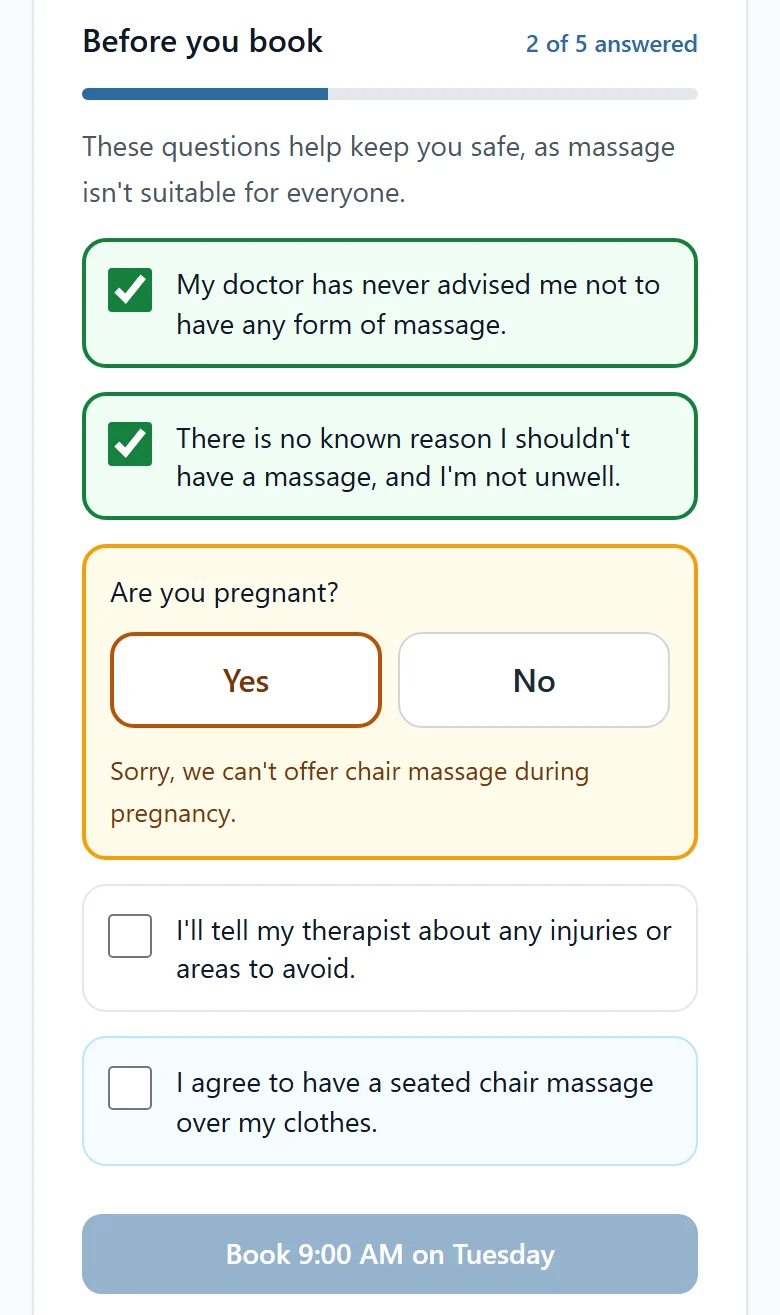
An example account. The business, the company and the people are all made up.
The app records that each person who books online confirmed your questions, which version they saw and when, but not their checkbox or yes-or-no answers. So it isn't a signed intake record. If your state or insurer asks for one, use this form alongside it. Our free chair massage sign-up sheet guide covers the booking side if you'd rather start on paper, and our guide to massage therapist insurance in the US covers what your insurer expects. If you're still setting your prices, see chair massage prices in the US.
Quick checklist
- Download the form. In the Word version, add your name or logo (and delete our footer line if you like).
- In the Word version, type in your business name, contact info, privacy policy link and how many years you keep forms, then print. Using the PDF? Write them on one copy and photocopy it.
- Check what your state board asks for, including how long to keep records and the rules for minors.
- Pack a clipboard, pens, spare forms and a folder for completed ones.
- Read every form before you start, and talk through any "yes" in private.
- Decline for today if you're not sure it's safe.
- Sign and date each form yourself.
- Keep forms locked away, for as long as your state or insurer says.
This guide is general information, not legal, insurance or medical advice. Rules differ between states and insurers, so check the details with yours.
Sources
- Associated Bodywork & Massage Professionals: Guidelines for public demonstration
- American Massage Therapy Association: Client intake form
- Mississippi State Board of Massage Therapy: Frequently asked questions (August 2025)
- National Center for Complementary and Integrative Health: Massage therapy, what you need to know (May 2019)
- American Massage Therapy Association: Massage and pregnancy (June 2018)
- American Massage Therapy Association: Massage and medication (December 2014)
- MotherToBaby: The pain of pregnancy, can massage or acupuncture safely help? (April 2018)
- Centers for Disease Control and Prevention: Data and statistics on venous thromboembolism (January 2025)
- 16 Texas Administrative Code §117.90
- 45 CFR 160.103: Definitions
- Centers for Medicare & Medicaid Services: Are you a covered entity? (March 2026)
- Washington Administrative Code 246-830-570: Record retention
- Massage & Bodywork magazine (ABMP): HIPAA, privacy laws and protected health information (July/August 2019)
- MASSAGE Magazine: Do massage therapists need liability insurance? (updated May 2026)
Sources checked on November 11, 2026. State rules, association guidance and federal guidance change, so check the current versions.