
The short answer: a 15-minute chair massage is usually done over clothing, without oil, using compression, kneading and friction, with your forearms doing more of the work than your thumbs. A simple routine is 2 minutes on each shoulder, 4 on the neck and 4 on the back, then a light "waterfall" to finish. That leaves enough time to wipe down the chair and change the face cradle cover before the next person.
I've been running chair massage days at offices since 2017, and I used to give the massages myself. Most people in an office don't ask for anything in particular. They just want a massage. For them I had one routine, and it fit a 15-minute slot every time.
This guide is for massage therapists. It covers the techniques that work in a massage chair, that routine step by step, and how to keep to time when people are booked one after another.
The 15-minute chair massage routine at a glance
| Part | Time |
|---|---|
| Check in and settle | About 30 seconds |
| Left shoulder | 2 minutes |
| Right shoulder | 2 minutes |
| Neck | 4 minutes |
| Back | 4 minutes |
| Waterfall to finish | About 30 seconds |
| Sit up slowly and stand | 30 seconds to 1 minute |
| Wipe down the chair, new cover | About 1 minute |
That's 12 minutes of hands-on work, plus the check-in, the finish and the reset, about 15 minutes in all, so the next person starts on time.
Chair massage techniques
Chair massage is normally given over clothing and usually without oil, with the person seated and resting forward slightly into the chair [1]. Anne Williams, writing in ABMP's Massage & Bodywork, says "most of the strokes you already use during table massage can be adapted" [2]. These are the ones that work best through clothing.
- Compression. Pressing and releasing with your palms, loose fists or forearms. It works well through clothing and is easy on your hands.
- Kneading (petrissage). Lifting and squeezing the muscle, mostly on the shoulders. Williams notes it's harder to grip the tissue through clothing, and that petrissage is "fatiguing for the therapist's hands and so should be used in moderation during a busy day of sessions" [2].
- Friction. Small circles or short strokes over one spot. Williams says superficial friction "is useful as a stroke to warm the tissue, even when applied over clothing" [2].
- Forearms and elbows. For deeper pressure on the upper back and shoulders. Williams suggests using "your elbows, fingers, knuckles, fists, and the ulnar edge of your hands" [2], which spares your thumbs over a long day.
- Light tapping. A few seconds of quick, light tapping can help people feel alert before they go back to their desk, if they like it. Keep it off the spine, and "tapotement over the kidneys and floating ribs is contraindicated" [2].
Stand in a lunge behind the person and use your body weight rather than your arm strength. Patrick Ingrassia, writing in MASSAGE Magazine, puts it as "use your body weight and momentum rather than muscular strength" [3]. Our guide to self care and body mechanics for massage therapists covers setting up the chair and protecting your hands, and there's more on what to wear for a day on your feet.
Before you start
Have the chair set before they arrive. Then a quick check-in, about 30 seconds, sets up the rest of the massage.
- Check in. Ask how they're feeling today, whether there's anywhere to avoid, and how much pressure they like. If they answered health questions when they booked, you only need to ask what might have changed since.
- Ask if they've eaten. Fainting in a massage chair is rare, but it does happen. David Palmer, writing for ABMP, says "the single greatest determining factor for syncope is whether you screen before" the massage, and suggests asking whether they've eaten in the past five hours. As with all screening, his rule is "when in doubt, don't" [4].
- Get them ready. Ask them to take off glasses, lanyards, scarves and large earrings, and to empty any bulky pockets, and let them know they can ask you to change the pressure or stop at any time. Ask before touching their hair.
- Set the chair. Set the seat, chest pad and face cradle for them so their chest rests on the pad, their neck is straight and their back is at a good height for you to lean into. A fresh face cradle cover goes on before they sit down.
- Let them settle. Rest your hands on their shoulders for a few seconds before you start. It lets them know where you are.
The chair massage routine, step by step
Work over their clothing throughout, and check the pressure early on with a quick "How's that?"
-
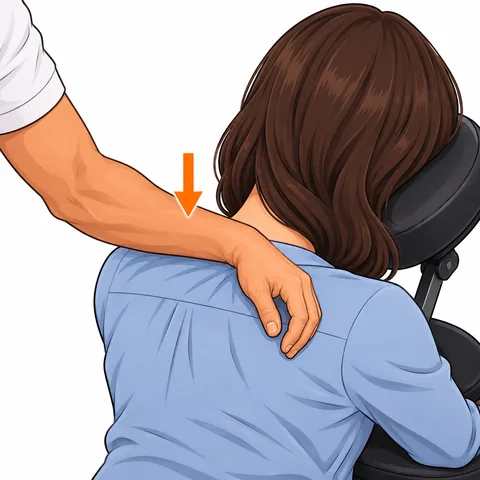
Left shoulder
Warm the top of the shoulder with compression and friction, knead along it toward the neck, then use forearm pressure on the muscle across the top of the shoulder, above the shoulder blade. Stay off the bony point of the shoulder and the collarbone.
2 minutes
-
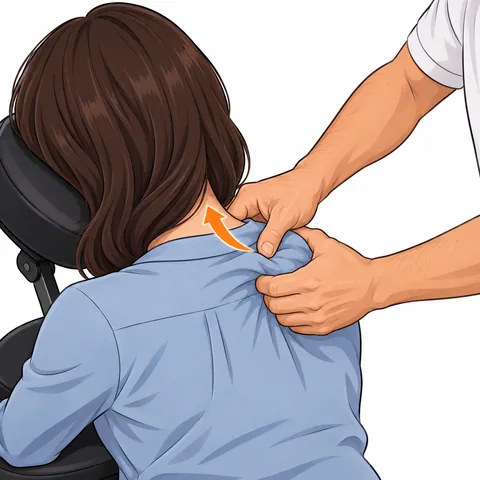
Right shoulder
The same on the other side. Giving both shoulders the same time means nobody feels one side was rushed.
2 minutes
-
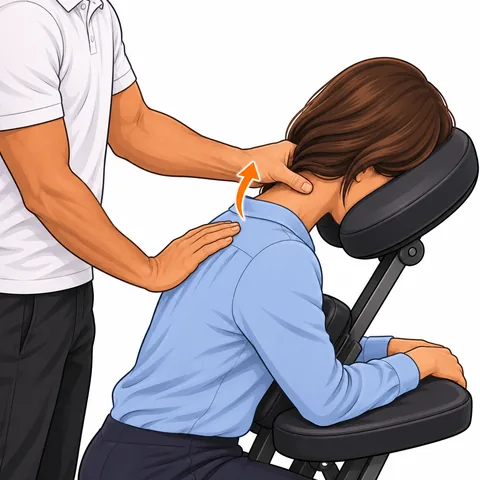
Neck
Work from one side of the chair, then the other, with their forehead resting in the face cradle. On each side, squeeze gently up the back of the neck from the shoulders to the base of the skull, then use slow circles along the muscles beside the spine. Stay on the back of the neck, never the front or near the throat, and keep off the bones of the spine. Go lighter than on the shoulders, and don't stretch or turn the head.
4 minutes
-
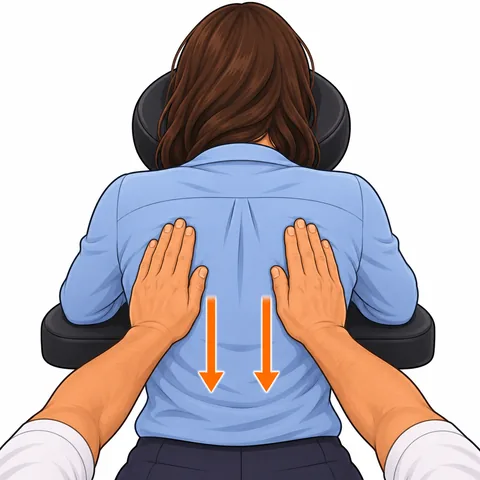
Back
Palm compressions down both sides of the spine, never on it, from the shoulders to the lower back. Go lighter over the lower ribs and lower back. Then work around the shoulder blades with your forearm or a loose fist.
4 minutes
-
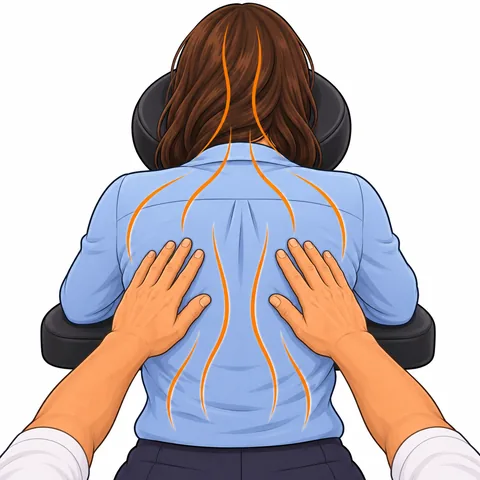
Waterfall
Light, flowing strokes with your fingertips and palms, from the top of the head down over the neck, shoulders and back, like water running down. It tells them the massage is ending.
About 30 seconds
-
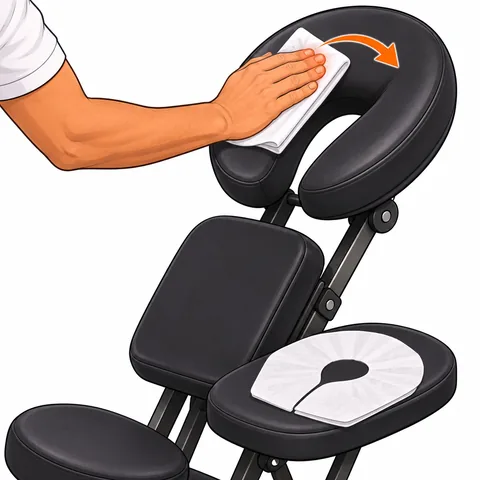
Sit up and reset
Ask them to sit up slowly and take a moment before they stand. Then reset the chair for the next person (see Between people).
1 to 2 minutes
Williams suggests having clients "sit up out of the face cradle at the end of the session" [2], which helps them avoid feeling lightheaded when they stand up.
The routine leaves out the arms and hands to keep the time for the shoulders, neck and back. If someone asks for something in particular, like their lower back, their forearms after a day at a keyboard or a sore shoulder, spend longer there and take the time from another part.
Using the same routine for everyone also keeps you on time. When every massage follows the same pattern, you know where you should be at minute 6 or minute 10, and you don't run over into the next person's slot.
Between people
If you don't set minutes between slots, the reset comes out of the 15 minutes, so keep the wipe-down to about a minute.
- Wipe down the chair where people touch it: the face cradle, armrest, chest pad and seat.
- Change the face cradle cover. A fresh one for every person.
- Wash or sanitize your hands, then shake them out and have a sip of water.
Onsite Days builds the day around your timings, including minutes between slots and your breaks. See how booking software for office massage days works, or try Onsite Days free.
Chair massage videos to watch
A routine is easier to learn when you can see it.
- The Best Chair Massage Routine for Clients (YouTube, 18 minutes), The Massage Professor. A full chair massage routine from start to finish.
- Chair Massage Techniques with Susan Salvo (YouTube, 7 minutes), Oakworks. Salvo is a massage educator and textbook author.
- Chair Massage: Techniques to Save Your Thumbs (YouTube, 10 minutes), Incorporate Massage by Nivati. Using your forearms and elbows on the upper back, shoulders and neck.
When to stop or change the routine
- If they feel faint. Palmer's advice is to "immediately stop the massage, lean over close to the client and ask if he is feeling okay" [4]. If they're still unwell, help them off the chair to lie down on the floor, with their legs raised if they can. If they pass out or don't come around quickly, call 911.
- If something hurts. Ease off or move on. A short chair massage isn't the place for deep work on a painful spot.
- If their health has changed. If they mention something new since they booked, such as a fever or recent surgery, it's better not to go ahead. For a new injury, avoid that area, and if you're unsure, skip the massage.
- If they're pregnant. On our own days we don't offer chair massage during pregnancy. If you're trained in prenatal massage, follow your training and your insurer's rules.
The risk of harm from massage is low, according to the National Center for Complementary and Integrative Health, but rare serious side effects have been reported, and "some of the reported cases have involved vigorous types of massage" [5]. In a 15-minute chair massage, less is often more. This guide is general information for licensed massage therapists, not medical advice.
Chair massage: common questions
What techniques are used in chair massage?
Mostly compression, kneading, friction and forearm or elbow pressure, through clothing and usually without oil, with light tapping if the person likes it. See Chair massage techniques.
How long is a chair massage?
A chair massage can last anywhere from 5 minutes to an hour, but people tend to prefer 15 to 20 minutes [6]. Fifteen minutes is long enough to work the shoulders, neck and back properly.
Do you use oil for chair massage?
Normally not. The person stays fully clothed, so the strokes are ones that work through clothing [1].
What is a waterfall in chair massage?
Light, flowing strokes from the head down over the neck, shoulders and back to finish the massage. Some therapists call these feather strokes. It lets the person know the massage is ending.
How many chair massages can you do in a day?
It depends on your hands and the length of each massage. On our days, we plan no more than six hours of massage in a day, with a 30-minute break every two hours.
Sources
- Nivati: What is Chair Massage? (2020, updated 2022)
- Anne Williams, ABMP Massage & Bodywork: Using Swedish Massage Techniques in Chair Massage (2015)
- Patrick Ingrassia, MASSAGE Magazine: Spinal Range of Motion Technique in the Massage Chair (updated 2024)
- David Palmer, MassageTherapy.com (ABMP): Fainting and Chair Massage
- National Center for Complementary and Integrative Health: Massage Therapy: What You Need To Know
- Nivati: Chair Massage Duration: How Long Is a Chair Massage? (2017, updated 2022)
Sources checked on November 18, 2026. This guide is general information, not medical advice.